Roast turkey with all the trimmings, followed by a flaming Christmas pudding: for many families, Christmas dinner is the most important meal of the year. But the menu we think of as traditional is surprisingly recent, and it has changed a great deal over the centuries.
Medieval feasting
In medieval England, Christmas was a festival lasting twelve days. Wealthy households celebrated with spectacular dishes: a boar’s head carried in to music, roast swans and peacocks, geese, brawn and rich pies. The custom of the boar’s head survives at The Queen’s College, Oxford, where it is still carried into hall each year with a medieval carol.
For ordinary people, a goose or another bird fattened for the occasion was a more realistic hope, and many relied on the generosity of their landlords.
The turkey arrives
Turkeys are native to the Americas and reached Europe in the early 16th century. A Yorkshire landowner, William Strickland, is traditionally credited with bringing some of the first turkeys to England around 1526, and his family coat of arms includes a turkey.
Turkeys gradually became popular, especially in East Anglia. Every autumn, great flocks of geese and turkeys are said to have been walked from Norfolk to the London markets, with their feet protected by tar or little leather boots.
Dickens and the Victorian Christmas
The Victorians did much to shape the Christmas we know today. In Charles Dickens’s A Christmas Carol (1843), the Cratchit family plan to eat goose, until a reformed Scrooge sends them the prize turkey hanging in the poulterer’s window.
For most of the 19th century, turkey remained a luxury and goose was more common. Many working families saved small amounts each week in a “goose club” to pay for their Christmas bird. Turkey only became affordable for most households in the 20th century, as farming changed after the Second World War.
Christmas pudding
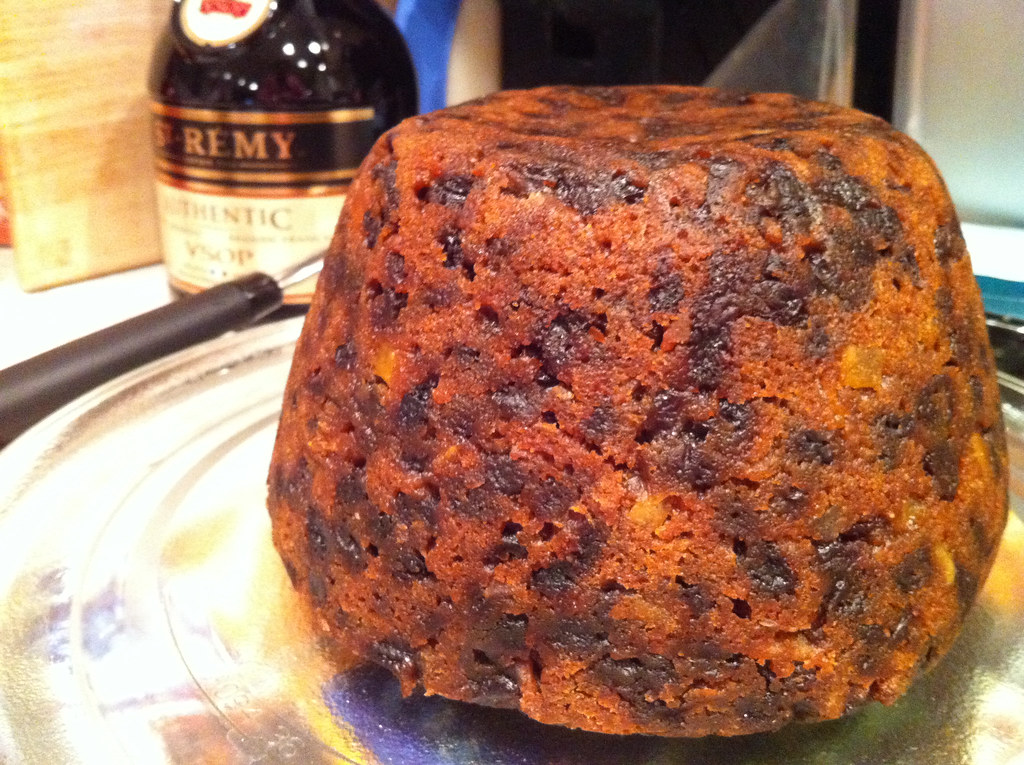
The Christmas pudding descends from medieval “plum pottage”, a thick mixture of meat, dried fruit, spices and wine. Over time the meat disappeared and it became a boiled pudding of suet, breadcrumbs and dried fruit. Confusingly, it contains no plums: in older English, “plum” could mean any dried fruit, especially raisins.
It is often said that Oliver Cromwell banned Christmas pudding. In fact, Puritan governments in the 1640s and 1650s tried to suppress Christmas celebrations as a whole, but there was no law against the pudding itself.
Families traditionally make their pudding on “Stir-up Sunday”, the last Sunday before Advent, named after a prayer that begins “Stir up, we beseech thee, O Lord”. Each member of the household stirs the mixture and makes a wish, and a silver coin is sometimes hidden inside.
Mince pies, too, have changed. They once contained minced meat mixed with fruit and spices, and only the suet remains as a reminder of their meaty past.
The modern Christmas table
| Dish | Origins |
|---|---|
| Roast turkey | Introduced from the Americas in the 16th century, widespread from the mid-20th century |
| Pigs in blankets | Sausages wrapped in bacon, popular since the later 20th century |
| Bread sauce | A medieval-style sauce thickened with breadcrumbs |
| Brussels sprouts | Grown in Britain since the 19th century |
| Christmas pudding | Descended from medieval plum pottage |
| Mince pies | Originally filled with minced meat and fruit |
Christmas crackers, which are pulled at the table, are credited to the London confectioner Tom Smith in the 1840s.
Key points
- Medieval Christmas feasts featured boar’s head, goose, swan and peacock
- Turkeys arrived from the Americas in the 16th century
- Dickens’s A Christmas Carol helped make turkey a Christmas symbol, but goose stayed more common for decades
- Christmas pudding descends from medieval plum pottage and contains no plums
- Mince pies were originally made with minced meat