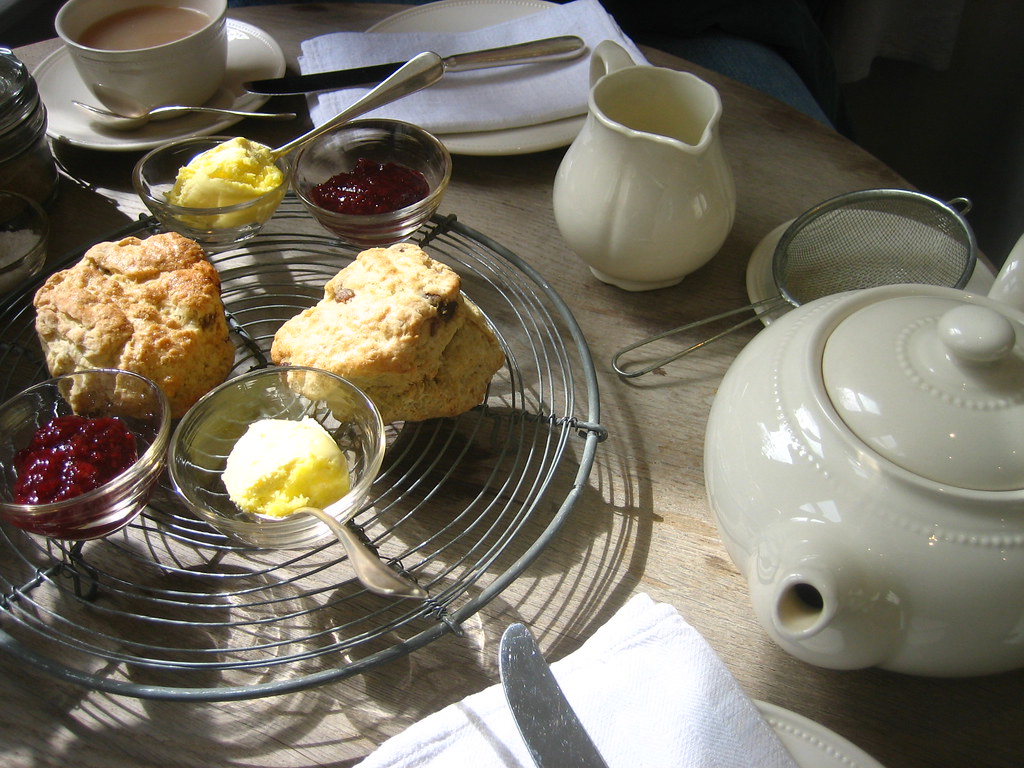
Delicate sandwiches, warm scones with clotted cream and jam, a tiered stand of cakes and a pot of tea. Afternoon tea is one of Britain’s most famous food traditions, and one of the few that can be traced, at least in legend, to a single person.
A duchess gets hungry
In the early 19th century, the fashionable dinner hour among the upper classes was moving later, often to seven or eight o’clock in the evening. That left a long gap after lunch.
Anna Russell, the 7th Duchess of Bedford, is credited with solving the problem in the 1840s. She began taking tea, bread and butter and cake in her rooms in the late afternoon, and soon invited friends to join her, both at Woburn Abbey and in London. The habit spread through fashionable society and became a social occasion in its own right.
Low tea and high tea
Afternoon tea was sometimes called “low tea”, because it was served on low tables in the drawing room. “High tea”, despite its grand-sounding name, was a working-class meal eaten at the high dining table after work, with hearty food such as meat, pies, bread and cheese alongside the tea.
That is why, in much of northern England and Scotland, “tea” still means the evening meal.
Tea rooms and hotels
In the late 19th century, tea rooms opened across Britain. The Aerated Bread Company opened tea shops in London from 1864, and J. Lyons followed with its own chain in 1894. Tea rooms were among the first respectable places where women could meet without a chaperone.
In Glasgow, Kate Cranston’s Willow Tea Rooms, opened in 1903 and designed by Charles Rennie Mackintosh, became famous for their striking interiors. Grand hotels such as the Ritz, opened in London in 1906, made afternoon tea a stylish occasion that still attracts visitors today.
What is on the stand?
A classic afternoon tea has three courses, usually served on a tiered stand:
- Finger sandwiches: cucumber, egg and cress, smoked salmon, ham and mustard
- Scones with clotted cream and jam
- Cakes and pastries, often including Victoria sponge, named after Queen Victoria
The great scone debate
No subject causes more friendly argument than the order of jam and cream on a scone:
| Devon | Cornwall | |
|---|---|---|
| First layer | Clotted cream | Jam |
| Second layer | Jam | Clotted cream |
Cornish clotted cream has had Protected Designation of Origin status since 1998. There is also the question of pronunciation: does “scone” rhyme with “gone” or with “bone”? Both are heard across Britain, and both have passionate defenders.
Key points
- Afternoon tea is credited to Anna Russell, 7th Duchess of Bedford, in the 1840s
- “High tea” was originally a hearty working-class evening meal, not a posh occasion
- Tea rooms from the 1860s onwards gave women new places to meet
- Devon puts cream first, Cornwall puts jam first