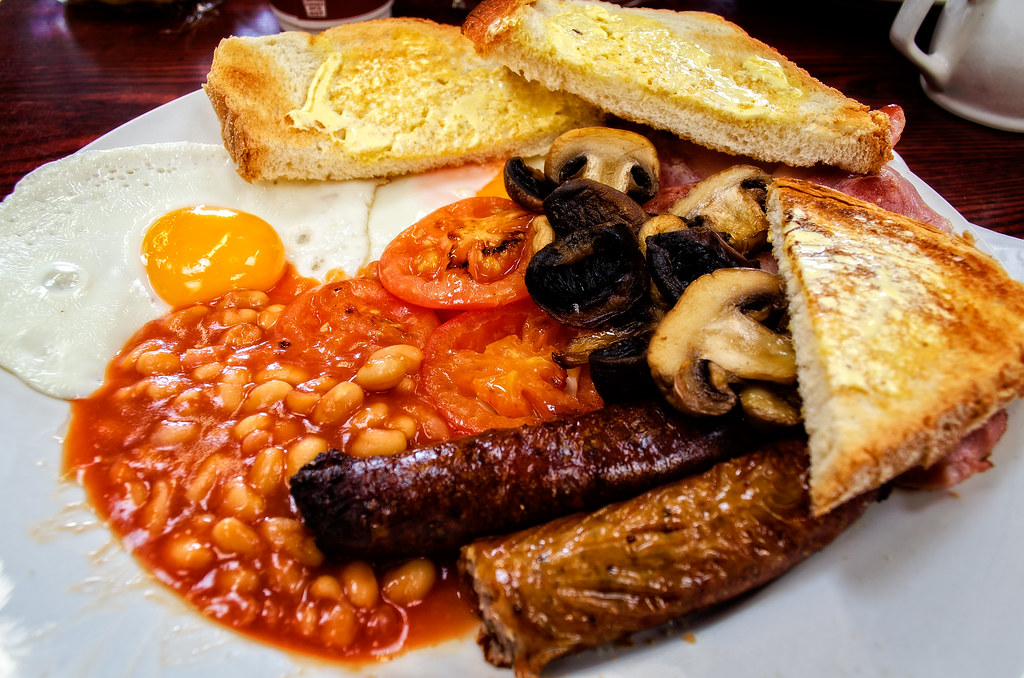
Bacon, eggs, sausages, grilled tomatoes, mushrooms, baked beans and toast. The full English breakfast is one of the most recognisable meals in the world, served everywhere from hotel dining rooms to motorway cafés. Its story moves from the country house to the factory gate.
Breakfast in the country house
In Victorian and Edwardian country houses, breakfast was a show of hospitality. Wealthy households laid out a spread of dishes on a sideboard, kept warm in silver dishes, and guests helped themselves: eggs, bacon, sausages, devilled kidneys, kippers, cold meats and toast.
Some of these dishes travelled a long way. Kedgeree, a mixture of rice, smoked fish and eggs, was adapted from khichri, a rice and lentil dish that the British encountered in India.
A breakfast for working people
As the industrial age went on, a cooked breakfast of bacon and eggs became an ideal, and for many families a reality, before a long day of physical work. By the early 20th century, bacon and eggs were widely regarded as the typical English breakfast. The writer W. Somerset Maugham is said to have joked that to eat well in England, you should have breakfast three times a day.
The café fry-up
Food rationing, which lasted until 1954, made a full cooked breakfast a rare treat for many years. Afterwards, cheap cafés, affectionately known as “greasy spoons”, served plates of fried food to builders, lorry drivers and office workers. The phrase “full English” itself seems to have become common only in the later 20th century.
Baked beans arrived in Britain as an imported luxury in the late 19th century. They became an everyday food after Heinz began producing them in Britain in the late 1920s, and today a full English without beans looks unusual to many people.
What goes on the plate?
There is no official recipe, and arguments about what belongs on the plate are part of the fun. The usual line-up includes:
- Back bacon and pork sausages
- Eggs: fried, poached or scrambled
- Grilled tomatoes and fried mushrooms
- Baked beans
- Black pudding
- Toast or fried bread
Hash browns are a more recent American addition, and some purists refuse to allow them anywhere near a full English.
Regional variations
Each part of the UK has its own version:
| Breakfast | Distinctive items |
|---|---|
| Full Scottish | Square (Lorne) sausage, tattie scones, haggis |
| Ulster fry | Soda bread and potato bread, both fried |
| Full Welsh | Laverbread (cooked seaweed) and cockles |
Key points
- Grand cooked breakfasts were a feature of Victorian country houses
- By the early 20th century, bacon and eggs were seen as the classic English breakfast
- After rationing ended in 1954, cafés turned the fry-up into an everyday meal
- Baked beans became a breakfast staple after Heinz began making them in Britain
- Scotland, Northern Ireland and Wales each have their own regional versions