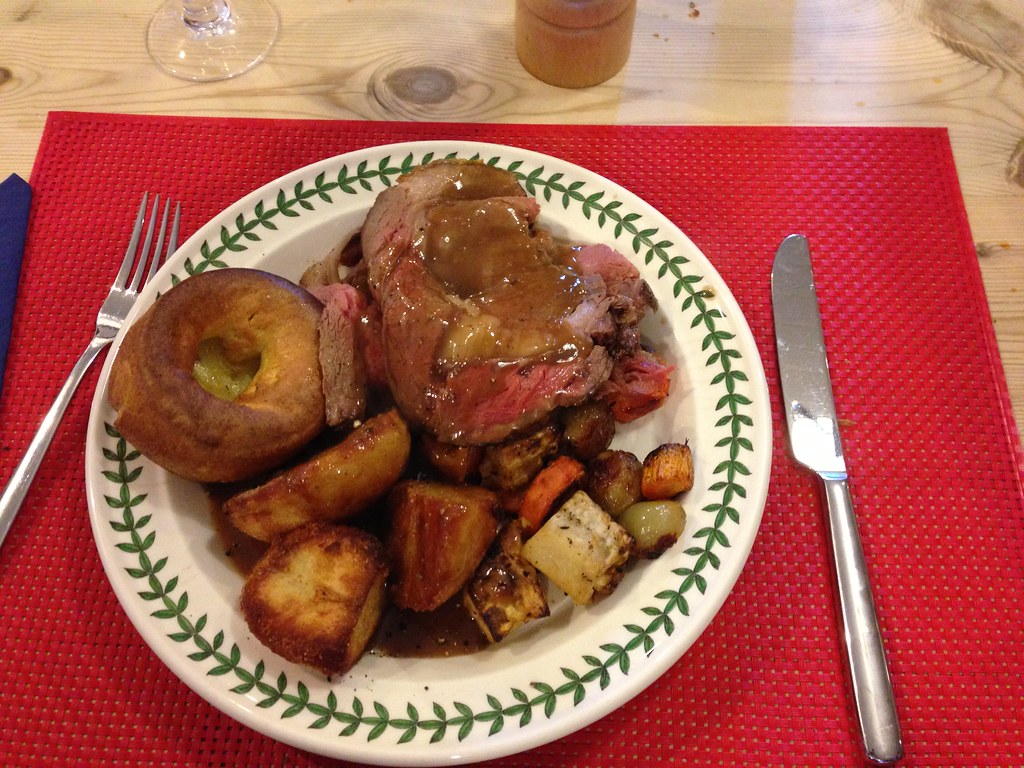
A joint of roast meat, crisp potatoes, Yorkshire puddings, seasonal vegetables and plenty of gravy: the Sunday roast is one of Britain’s best-loved meals. It brings together a centuries-old pride in roast beef, the rhythms of the working week and a clever way of making expensive meat go further.
Roast beef and national identity
By the 18th century, roast beef had become a symbol of England itself, standing for plenty and for a well-fed people who, so the story went, were stronger than their supposedly underfed French neighbours.
Henry Fielding’s song “The Roast Beef of Old England” (1731) celebrated the meat, and William Hogarth’s painting O the Roast Beef of Old England (1748) contrasts a huge joint of English beef with thin, hungry French soldiers at Calais. Across the Channel, the English earned the nickname “les rosbifs”, which is still used today.
The Yeomen of the Guard, the royal bodyguard, are popularly known as “Beefeaters”. The name is often linked to the generous rations of beef they once received, although the exact origin of the word is debated.
Spits, ovens and the local baker
Before ovens were common, roasting meant turning a joint on a spit in front of an open fire. In larger kitchens this was the job of a kitchen boy or, in some houses, a small “turnspit dog” running inside a wheel.
Many poorer households had no oven at all. In towns it was common for families to take their Sunday joint to the local baker, who cooked it in his bread oven while they were at church. Strictly speaking, much of what we call “roast” meat today is baked in an oven rather than roasted in front of a fire.
Why Sunday?
For centuries Sunday was the only day of rest for most working people. After church, the family gathered for the most substantial meal of the week, and leftovers stretched into Monday’s meals. Cold meat, and “bubble and squeak” made by frying up leftover potatoes and cabbage, made sure nothing was wasted.
The Yorkshire pudding
A batter pudding cooked beneath roasting meat, to catch the dripping fat, was described as a “dripping pudding” in The Whole Duty of a Woman (1737). Ten years later, Hannah Glasse’s best-selling The Art of Cookery Made Plain and Easy (1747) gave it the name we use today: Yorkshire pudding.
Traditionally the pudding was served first, with gravy, so that diners would fill up before the more expensive meat arrived. It is a much-repeated explanation that is hard to prove, but it fits the thrifty logic of the meal. In 2008 the Royal Society of Chemistry declared, partly in jest, that a Yorkshire pudding is not a true Yorkshire pudding unless it rises to at least four inches.
The trimmings
Each meat has its own traditional partners:
| Meat | Traditional accompaniments |
|---|---|
| Beef | Yorkshire pudding, horseradish sauce, English mustard |
| Lamb | Mint sauce or redcurrant jelly |
| Pork | Apple sauce, crackling, sage and onion stuffing |
| Chicken | Bread sauce, stuffing, pigs in blankets |
The roast today
Fewer families sit down to a home-cooked roast every week than in the past, but the meal has found a second home in pubs and carveries. On a Sunday afternoon, a pub roast remains one of the most popular meals out in Britain.
Key points
- Roast beef became a symbol of English national identity in the 18th century
- Many families once had their Sunday joint cooked in the local baker’s oven
- The Yorkshire pudding was first named in print by Hannah Glasse in 1747
- Each roast meat has its own traditional sauces and trimmings
- Today the Sunday roast is as much a pub meal as a family one