Today we turn a knob and the oven heats up. For most of British history, cooking meant tending a fire for hours every day. The story of the kitchen range is the story of how that work changed.
Cooking on an open hearth
Medieval and Tudor kitchens were built around a large open fireplace. Meat was roasted on spits in front of the fire, cauldrons hung from iron cranes over the flames, and bread was baked in ovens built into the wall beside the hearth.
Great houses had enormous kitchens. The Tudor kitchens at Hampton Court Palace, built for Henry VIII, could feed hundreds of courtiers twice a day, and they can still be visited. In ordinary homes, a single hearth was used for heating, cooking and boiling water.
Count Rumford and the enclosed range
Open fires wasted most of their heat up the chimney. In the 1790s, the American-born scientist Benjamin Thompson, Count Rumford, designed enclosed cooking stoves that used fuel far more efficiently.
During the 19th century, the cast-iron kitchen range became standard in middle-class homes. A typical “kitchener” had a coal fire in the centre, an oven on one side and a boiler for hot water on the other. It was a great improvement, but it needed constant attention, and blackleading the range to stop it rusting was one of the most hated chores for domestic servants.
Gas arrives
Gas cooking was being demonstrated by the middle of the 19th century; the celebrated chef Alexis Soyer used gas in his kitchens at the Reform Club in London. Gas cookers became common in the late 19th century, when gas companies began renting them out and installing coin-operated “penny in the slot” meters, so that working-class households could pay for their gas as they used it.
Electric cookers appeared around the turn of the 20th century, but they only became common after the National Grid brought reliable electricity to most homes from the 1930s onwards.
The Aga
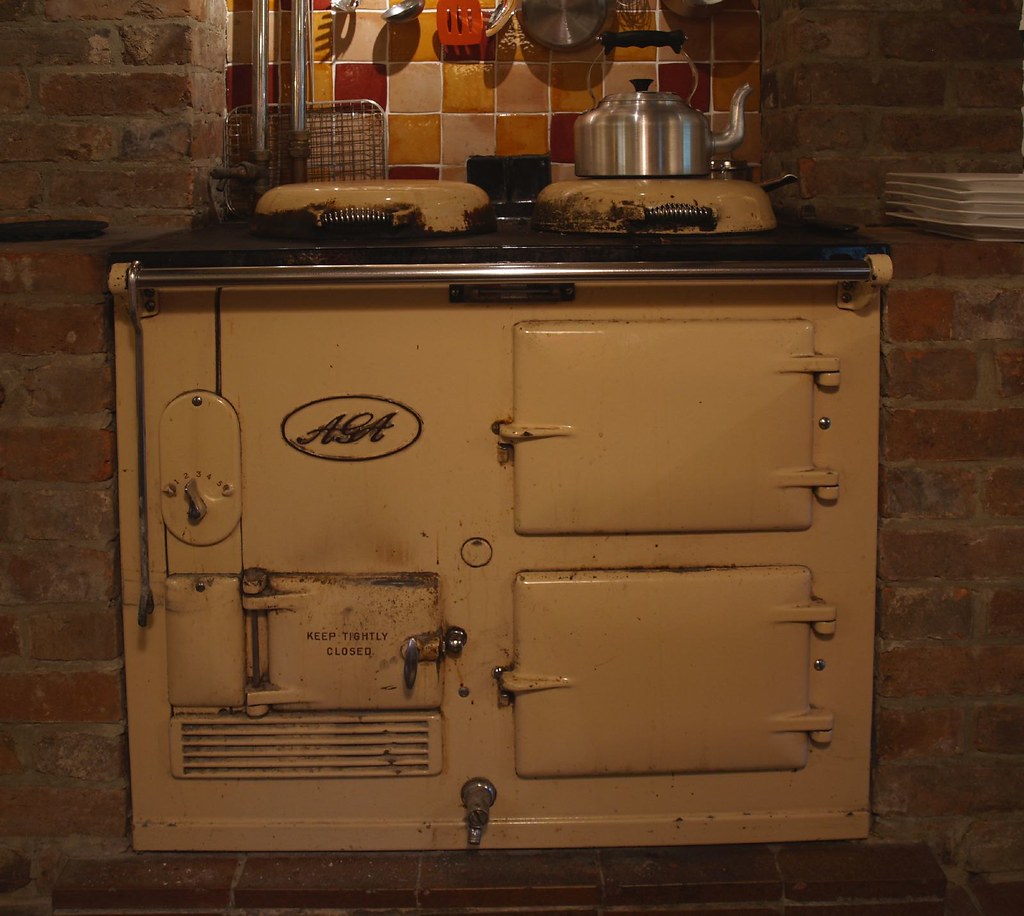
The Aga was invented by Gustaf Dalén, a Swedish physicist who won the Nobel Prize in Physics in 1912. After an accident left him blind, he spent time at home and designed a stove that would be efficient and easy for his wife to use.
The Aga stores heat in a heavy cast-iron body and keeps its ovens and hotplates at steady temperatures, with insulated lids to keep the heat in. It was introduced to Britain in 1929 and has been made in Coalbrookdale, Shropshire, for many decades. It became a symbol of the country kitchen, so much so that novels about comfortable rural family life were nicknamed “Aga sagas”.
Key points
- For centuries, British cooking took place over an open hearth
- Count Rumford’s enclosed stoves of the 1790s led to the cast-iron range
- Coin-operated meters helped make gas cookers common in the late 19th century
- Electric cookers spread after the National Grid was built in the 1930s
- The Aga, invented by Nobel laureate Gustaf Dalén, arrived in Britain in 1929